
“Drink eight glasses of water a day” is the most repeated health tip in the English language, and it isn’t really wrong — it’s just not a target, it’s a rounding error. Eight 8-ounce glasses works out to about 1.9 liters, which happens to be in the right neighborhood for a lot of adults. But it was never measured for you specifically, and treating it as gospel is why so many people either chronically under-drink or wash it down with three coffees and call it even.
Here’s a more useful way to land on a number, and then the part that actually matters: what you do with it once you have it.
Start from a real reference point, not a rule of thumb
The U.S. National Academies of Sciences, Engineering, and Medicine puts adequate total daily fluid intake at roughly 3.7 liters (about 125 oz) for men and 2.7 liters (about 91 oz) for women. That figure includes water from food and every beverage you drink, not just plain water from a glass — food alone typically supplies about 20% of it.
Strip out the food estimate and you land close to where most hydration guidance already sits: roughly 2.7–3.7 liters a day from drinks, adjusted for your size, activity, and climate. That range, not “eight glasses,” is the honest starting point.
Then adjust it for your actual life
A baseline number is only useful once you push it around to fit your day. A few things reliably move it:
- Body size. A larger body generally needs more total fluid than a smaller one.
- Activity and sweat. A workout, a physical job, or a hot commute all add to what you lose and need to replace.
- Climate. Heat and humidity increase fluid loss you may not notice happening.
- Caffeine and alcohol. Both have a mild diuretic effect, so a heavy coffee day quietly raises your real target.
- Pregnancy, breastfeeding, illness, or a medical condition. These change fluid needs in ways a generic number can’t account for — that’s a conversation for a doctor, not an app or a blog post.
The simplest gut-check: your body is already telling you
If you don’t want to do math, two low-effort signals get you most of the way there:
- Urine color. Pale yellow, like lemonade, is a good sign. Dark yellow means drink more; consistently clear can just mean you can ease off.
- Thirst. It’s a real signal, not a failure state — the trick is catching it early instead of ignoring it through a whole meeting.
A number only matters if you track it
Which raises the practical question of what to track it in. Any of the main water tracking apps for iPhone will hold a custom goal and tally against it — they differ mostly in what keeps you coming back, not in the arithmetic.
Here’s the part the “how much water” articles usually skip: knowing your target changes nothing on its own. The gap between people who hit their number and people who mean to is almost always a logging problem, not a willpower problem. If drinking water doesn’t leave a trace anywhere, it’s invisible — you can’t tell at 4pm whether you’re at 20% or 80% of the way there, so you either forget it entirely or overcorrect by chugging a liter right before bed.
That’s the whole idea behind AquaJoy. You set your target once — your own number, not eight generic glasses — then log a drink in one tap with quick-add buttons sized to how you actually drink. Your progress bar updates instantly, reminders run on a schedule you pick and go quiet the moment you hit your goal, and every glass logged earns XP toward a level and a streak, so the habit has some feedback instead of disappearing into a mental tally you keep losing track of.
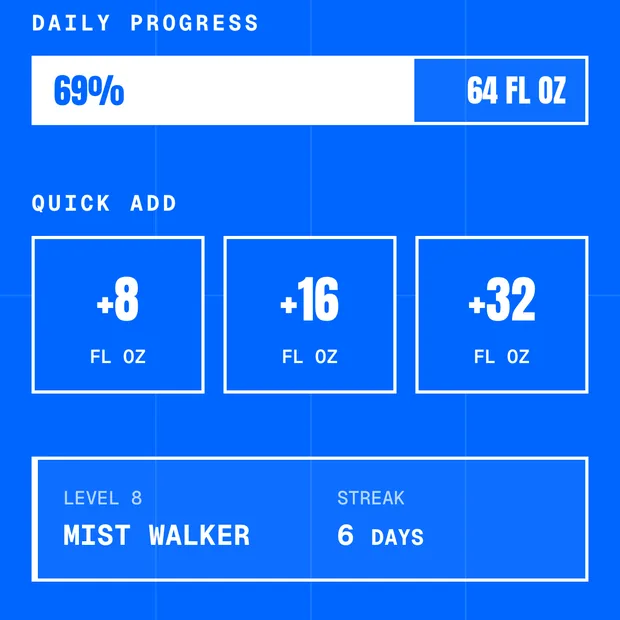
Set your number once. Then it’s one tap a day.
Download AquaJoy freeThe short version
- Start around 2.7–3.7 liters a day from drinks, then adjust for your size, activity, climate, and habits.
- Use urine color and thirst as an ongoing gut-check, not just a one-time calculation.
- Pick a number and actually track it — that’s the step that turns a target into a habit.
Once you have your number, the next problem is hitting it consistently — that's covered in how to build a hydration habit that actually sticks.
This is general information, not medical advice. If you have a health condition that affects how much fluid you should drink, talk to a doctor about your own number.
