
Nobody struggles to drink water because it’s hard. It costs nothing, takes five seconds, and there’s a tap in every room. And yet most people who decide to “drink more water” are back to their old baseline within two weeks.
That’s the tell that this isn’t a willpower problem. Willpower problems are things like cold plunges and 5am workouts — genuinely unpleasant things you have to force. Drinking water is neither hard nor unpleasant. It fails for a different reason: it produces no feedback.
The core problem: water is invisible
Habits that stick almost always have a visible result. You go to the gym, you get sore. You save money, the balance goes up. You learn guitar, you can play a song you couldn’t play last month.
Drinking water produces none of that. You drink a glass and nothing observable happens. Drink well for a whole day and you feel roughly the same as a day you didn’t. The benefits are real but slow, diffuse, and easy to attribute to something else.
Worse, you can’t even tell where you stand. Ask someone at 4pm how much water they’ve had and most will guess, badly. When you can’t measure the thing, you can’t tell a good day from a bad one, so there's nothing to course-correct against.
Everything below is about fixing that.
1. Make the target concrete
“Drink more water” is not a goal, it’s a sentiment — there’s no way to succeed or fail at it, so there's no way to build momentum. Replace it with a number you can hit or miss: 64 oz, 2 liters, whatever fits you. (If you don’t know your number, start with how much water you should actually drink a day.)
A specific target converts a vague intention into a binary outcome, which is the raw material every other technique here needs.
2. Make the progress visible
Once you have a number, you need to see where you are against it at any moment. This is the single highest-leverage change, because it turns an invisible habit into a visible one.
Seeing “38 of 64 oz” at 3pm does something a mental guess can't: it tells you you're behind while there's still time to fix it. Without that, you only discover you fell short at bedtime, when the day is already over and the information is useless.
3. Attach it to things you already do
New habits stick better when they piggyback on existing ones rather than trying to carve out their own space. You already have a reliable daily structure — use it as the trigger:
- A glass when you wake up, before anything else.
- A glass with every meal.
- A glass when you sit down at your desk, and when you get back from a break.
- A glass before bed, if it doesn’t wreck your sleep.
That’s six glasses without setting a single reminder, anchored to events that already happen on their own.
4. Remove every step you can
Friction kills habits far more reliably than lack of motivation. Two forms matter here:
Friction on the drinking: keep water within arm’s reach. A bottle on your desk gets drunk; a kitchen two rooms away doesn’t. If you have to decide to go get water, you'll often decide not to.
Friction on the logging: if tracking takes more than a second or two, you'll skip it, and your numbers drift from reality until the whole system stops being worth trusting. One tap is about the maximum that survives daily use.
5. Give the habit a scoreboard
This is the whole premise behind gamified water tracker apps — pets, collections, XP and ranks are four different answers to the same missing-feedback problem.
This is where gamification earns its keep, and it’s not a gimmick — it’s a direct fix for the invisibility problem. Since drinking water produces no natural feedback, you add an artificial layer that does:
- Streaks turn isolated days into a chain you don’t want to break. A 12-day streak makes day 13 meaningfully harder to skip than it would be on its own.
- XP and levels make individual logs count toward something cumulative, so a single glass isn’t a rounding error — it's progress on a bar that doesn't reset at midnight.
- Milestones and badges mark progress you'd otherwise never notice, and give the habit occasional moments worth caring about.
None of this changes the water. It changes whether your brain registers that anything happened — which is precisely what was missing.
6. Let streaks break without quitting
The most common failure mode isn't missing a day — it's what happens after. You break a 20-day streak, feel like the project is ruined, and stop entirely. This is where most habits actually die: not from the miss, but from the all-or-nothing response to it.
A missed day is one missed day. Your average across a month is what matters, and one blank square barely moves it. Start the next streak the following morning and keep going.
How AquaJoy applies this
AquaJoy is essentially this list turned into an app. You set a specific goal (1), a progress bar shows exactly where you stand all day (2), and logging is one tap with quick-add sizes so friction stays near zero (4).
The scoreboard layer (5) is the part most water trackers skip: every log earns XP toward one of 100 levels, daily goals build streaks, and hydration milestones unlock collectible pins. Reminders can cover the anchors you don't hit naturally (3), and they stop for the day once you hit your goal — more on that in water reminders that don't turn into nagging.
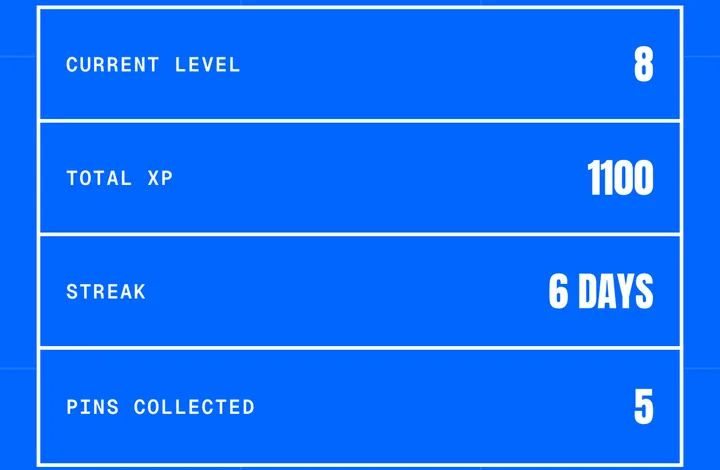
Give the habit something to show for itself.
Download AquaJoy freeThe short version
- Pick a specific daily number, not “more water.”
- Make your progress against it visible at any moment.
- Anchor glasses to routines you already have.
- Keep water within reach and logging to one tap.
- Add a scoreboard, because the habit doesn’t come with one.
- When you miss a day, start again the next one.
This is general habit and hydration information, not medical advice. If a health condition affects how much fluid you should drink, talk to a doctor about your own target.
